
Hot MessWildfire Command
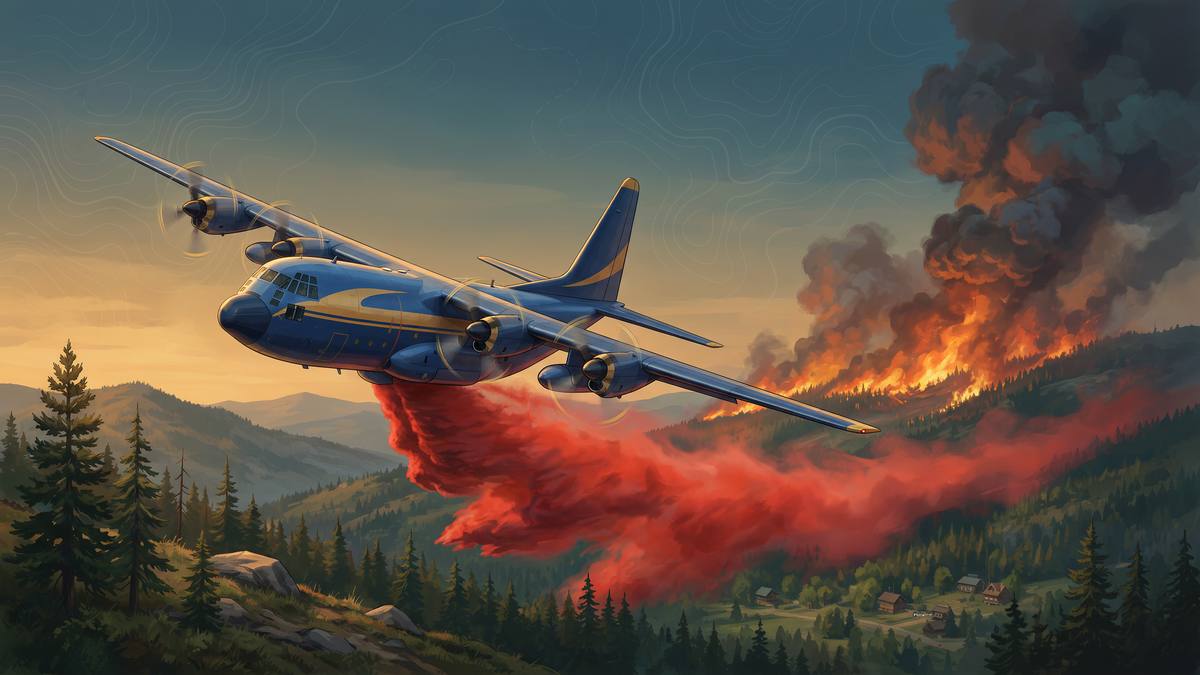
Illustration: a cobalt and gold air tanker lays a long red line of retardant between a wildfire and a village in the forest.

Aerial firefighting · for iPhone

Hot Mess:WildfireCommand

Draw the drops. Hold the line.

Command the crews and aircraft of a warming century, from a grass fire in 2026 to the fire days of the 2090s. A real-time strategy game about wildfire, on real land.

Free · iOS 17 or later · no account

  • 28Fires on real land
  • 11Crews, engines and aircraft
  • 2026–2100One warming century
  • 3–9 minA fire, start to finish
Illustration: an incident commander at a field table with a topographic map and a radio, looking out of a tent at a smoke column and a passing tanker.

How it plays

You are the incident commander

Every fire starts with a briefing and a field map. Then it is yours: real time, one finger, and a fire that does not wait.

Illustration: seen from beside the cockpit, a tanker lays retardant over burning Mediterranean terraces below a white village.
Air attack01

Draw the drops

Drag a line across the land and the aircraft flies it. A helicopter dips its bucket in the lake, a scooper skims the water, a tanker lays a red curtain of retardant ahead of the fire. Where you draw, it drops.

  • Water from helicopters and scoopers
  • Retardant lines from air tankers
  • Crews, dozers and smokejumpers dig the lines you draw
In the game: a drop being drawn, a red line traced across a hillside ahead of the fire.
Illustration: an amphibious scooper skims an Australian river between red banks and gum trees, a fire burning on the far hills.
Fire behaviour02

A fire that reads the land

The fire runs with the wind, races up slopes and slows on the way down. Dry grass carries it fast, timber burns hot, and creeks, roads and bare rock hold it. When the wind shifts, the head turns; on the worst days, embers start new fires beyond your line.

  • Wind, slope and fuel decide the spread
  • Wind shifts, new fronts and flare-ups
  • Day, golden hour, dusk and night fires
In the game: a wildfire running uphill through a forested canyon, its smoke leaning with the wind.
Illustration: a helicopter with a water bucket over the High Fens in Belgium, a boardwalk crossing the moor and a low line of fire on the horizon.
The map table03

Real places

Each fire is set on real fire-prone land, with real elevation where it matters. The briefing opens a field map: where the fire started, which way the wind will push it, and the houses at stake.

  • Tehama County
  • Attica
  • Okanagan Lake
  • Yakutia
  • Blue Mountains
  • Serra de Monchique
  • Provence
  • Fort McMurray
  • The High Fens
In the game: the briefing for the Wind Shift fire in Attica, Greece, a topographic field map with the start, the wind and the units to dispatch.
Illustration: the whole fleet on one hillside, a helicopter with a bucket above, a dozer cutting a line through the grass and an engine waiting on the road below.
Headquarters04

Build the fleet

Every fire pays. Spend it at headquarters on new units and upgrades, from a single hand crew to engines, dozers, smokejumpers, helicopters, scoopers and air tankers. Real kinds of firefighting units, flown in the fleet's own cobalt and gold.

  • Eleven units, each with its own job
  • Upgrades: bigger tanks, faster turnarounds
  • A collector card for every aircraft
In the game: the fleet card of the Large Air Tanker, its speed, load, drop width and turnaround.

Screenshots

The real game

The illustrations set the mood; this is what you play.

An air tanker lays retardant ahead of the fire while hand crews dig a line.
Tanker on the head
A helicopter drops water on the fire's edge while crews cut a line below.
Bucket drop
A drop being drawn across a hillside ahead of the fire.
Draw the drop
A night fire by Okanagan Lake, the fire glowing among dark trees.
Night flare-up
The briefing's field map for a fire in Attica, Greece.
The briefing
The Large Air Tanker's fleet card.
The fleet
The debrief: Contained, two stars of three, the score and a timelapse map of the fire.
Contained

The century

Each decade burns hotter

The campaign runs from 2026 to 2100. Every decade's fires burn drier and windier, with longer seasons and more fronts at once. What changes is how well you meet them.

  1. 2026+1.4 °C
  2. 2050+2.1 °C
  3. 2080+3.1 °C
  4. 2100+3.7 °C

The warming follows a set high-emissions scenario, close to the IPCC's SSP3-7.0 median, and nothing in the game moves it. The fire behaviour is simplified; the direction is real: hotter, drier years make wildfires spread faster and harder to stop.

Illustration: the same valley in three eras, green, then dry gold, then burning under an orange sky, crossed by one tanker.

Questions

Before you fly

Is it free?

Yes. The game is free and every fire in it is free to play. Some ads play between fires. One optional purchase, the Full game, removes every ad and makes headquarters builds instant. It never changes a score or a fire.

What do I need to play?

An iPhone with iOS 17 or later. There is no account and no sign-in.

Are the places and the aircraft real?

The places are real fire-prone land, from California's foothills to Belgium's High Fens. The fires are not replays of real events. The units are real kinds of firefighting crews, vehicles and aircraft, with generic names and the game's own livery.

How long does a fire take?

Three to nine minutes. You can pause at any time, and a retry is always free.

Is the science right?

The fire model is simplified so it plays on a phone, but it follows the real drivers: wind, slope, fuel and moisture. The warming of the century follows a published high-emissions scenario, and every fact shown in the game is true.

Is it on Android?

Not yet. Hot Mess: Wildfire Command is on iPhone for now.

More help on the support page.

The fire won't wait

Your first fire is a grass fire in 2026, with one hand crew. Go.

Download on the App Store